
Brand Identity Skill
A Claude Code skill that designs a brand identity as one system: logo, typography and colour palette built together from one brief, measured, compared as identity cards, and…
Install
/plugin marketplace add fatihaydost/brand-identity-skillInstall command taken from the project's README or registry entry. Always review code before running it.
README excerpt
Read full README on GitHub →brand-identity
A skill for Claude Code that designs a brand identity as one system: logo, typography and colour palette built together from one idea, measured, shown side by side as identity cards, and handed over as a brand guidelines kit for the set you pick.
Twenty-four briefs, one direction shown from each: a light festival in Lyon, a taquería in Mexico City, a pharmacy in Athens, a techno label in Berlin, a floating sauna in Oslo, a children's dentist, a weeding-robot start-up, a honey co-op on the Black Sea and more. Mascots, emblems, monograms, stencils and plain wordmarks; every mark, typeface and colour above came out of a run of this skill.
What you get · Examples · Install · Use · How it works · Network and privacy · Develop
What you get
- Three (up to four) identity sets, each built around a single mechanism that produces the mark, the type choice and the palette at once, so the parts belong together instead of being picked separately.
- Measured, not asserted. Contrast (WCAG 2.2), colour-blindness simulation, glyph coverage for the languages the brand writes in, font licences, tabular figures, and logo renders at 16 and 32 px for review. A failed measurement is a gate the set must pass; a heuristic is labelled as a warning; taste is labelled as judgement.
- Sets that don't look like every other AI brand. The skill knows what plain models reach for and asks for a reason from the brief whenever a set uses it (below).
- A brand guidelines kit for the chosen set: an 8-page PDF (cover, idea, logo, variations, logo on colour and
misuse drawn for this mark, colours, typography, applications;
--fulladds grid, dark mode, accessibility, iconography and imagery for 13), logo files (SVG and PNG: full colour, one colour, reversed, app icon, favicon), design tokens (CSS, SCSS, Tailwind, DTCG JSON) and a font sheet with embed code. - Your site, restyled. Give it a URL and it reads the current logo, type and colours, then previews each set on
your own pages. Keep the parts you like (
keep), evolve others (refresh). - Any part on its own: just a logo, just a type system, a palette for an existing logo, or a critique of an identity you already have.
Examples
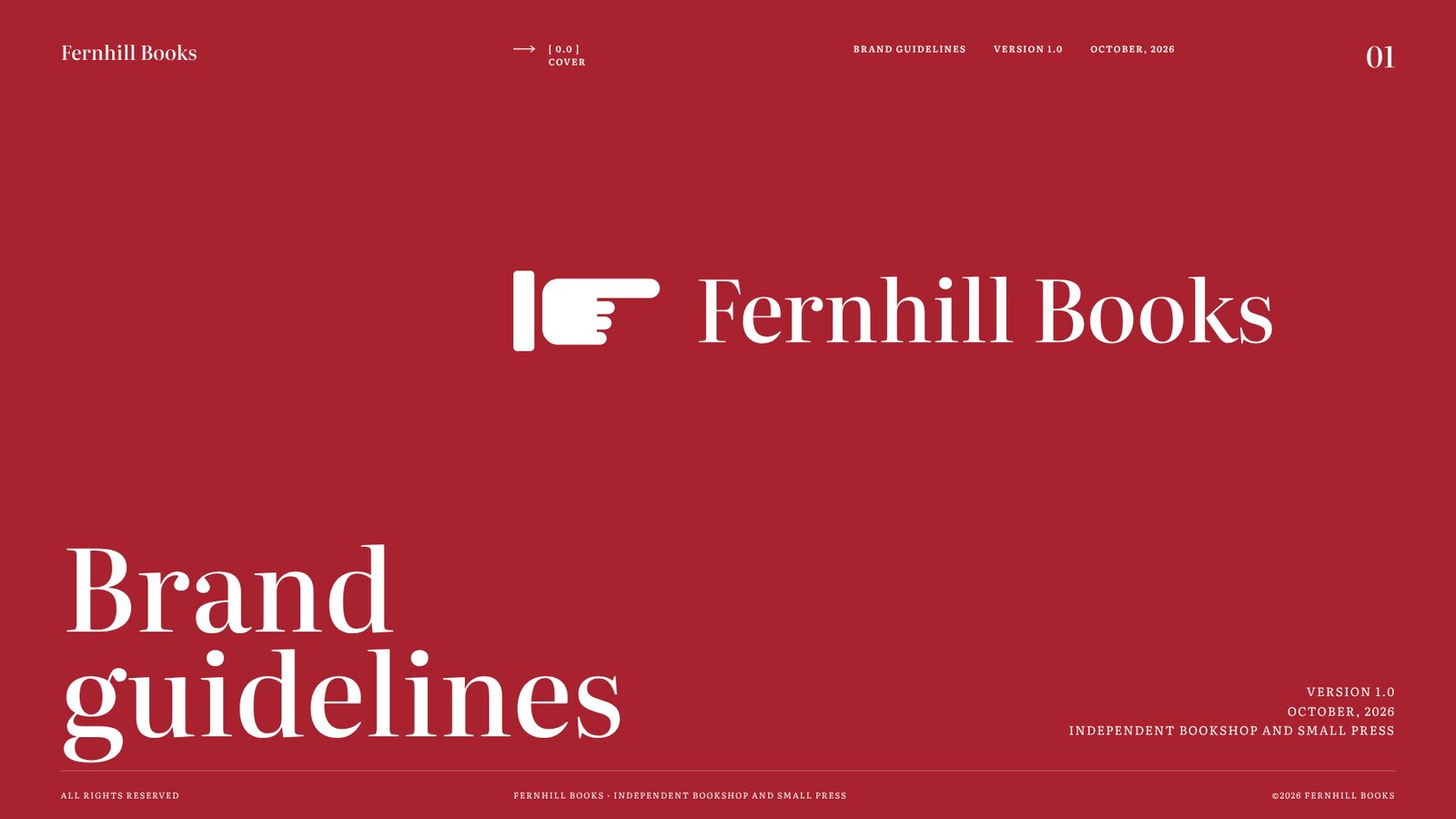
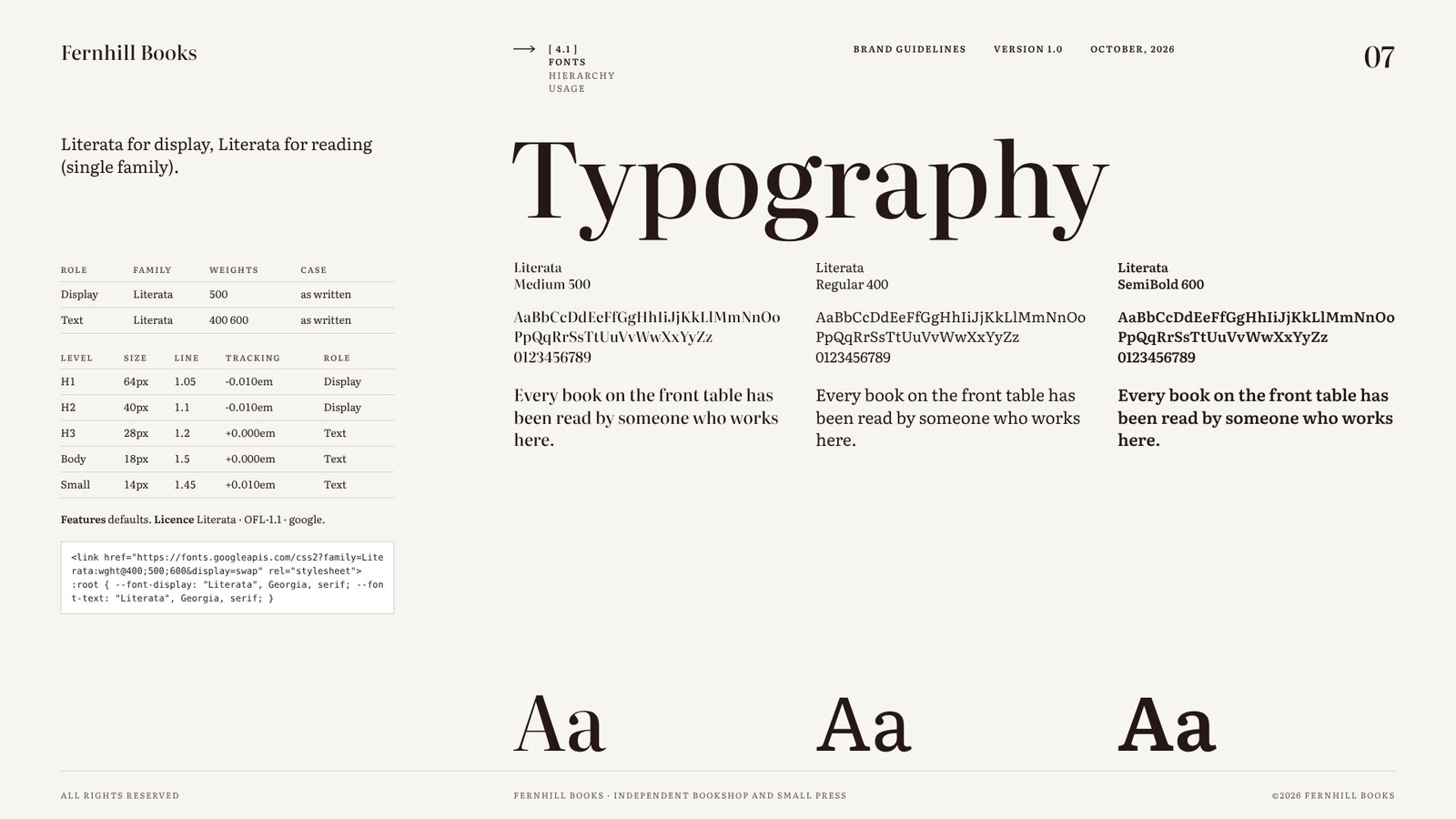
Fernhill Books: an independent bookshop and small press in Edinburgh
Brief: literate, unhurried, wry. Competitors: a national chain in navy and white, a second-hand shop with a gilt sign, an online marketplace.
A · Manicule (recommended, picked): the pointing hand readers drew in margins is the mark, Literata carries both display and text, and the palette is press black with one rubric red. B · Full Stop: a quiet lowercase name that ends on a blue proofreader's full stop. C · Close: an Old Town passage under a tenement, on a dark ground.
| Kit: cover | Kit: typography |
|---|---|
 |
 |
Tessellate: an open-source data pipeline orchestrator
Brief: precise, calm, candid; the product shows run times and costs, so figures must be tabular. Competitors: an established scheduler with a pinwheel logo, two start-ups in purple and teal.
Similar plugs


Makes your AI agent think like the laziest senior dev in the room. The best code is the code you never wrote.

An AI skill that provides design intelligence for building professional UI/UX across multiple platforms.

Turn any codebase, with its docs, SQL schemas, configs, and PDFs, into a queryable knowledge graph. A /graphify skill for Claude Code, Cursor, Codex, and Gemini CLI: local…

Why use many token when few token do trick. Viral skill + proxy for coding agents that cuts 65% of tokens by talking like a caveman.
